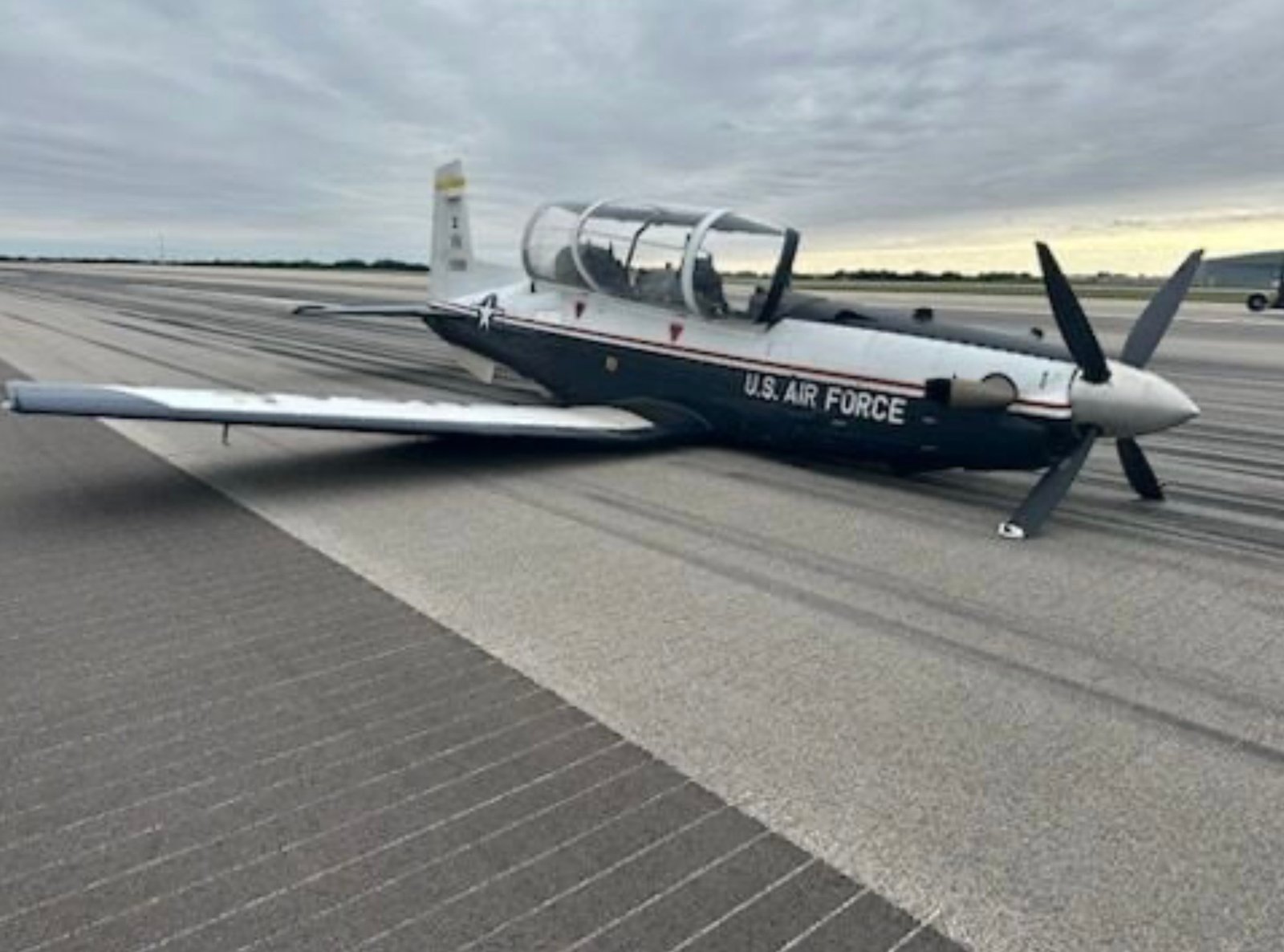
An unexpected emergency landing disrupted normal airfield operations at McConnell Air Force Base in Kansas, drawing immediate attention from aviation analysts and military flight enthusiasts. A United States Air Force T-6A Texan II training aircraft, operating out of Vance Air Force Base in neighboring Oklahoma, was forced to execute a gear-up belly landing on the McConnell runway.
Military flight training involves high repetitions, continuous sorties, and rigorous adherence to safety protocols. When an airborne mechanical malfunction occurs, the success of the outcome relies entirely on the training of the crew and the rapid coordination of ground assets. The incident at McConnell served as a live demonstration of these emergency protocols functioning exactly as designed, resulting in zero injuries and minimal secondary damage to the airfield infrastructure.
Aircraft Type:      Beechcraft T-6A Texan II
Origin Base:        Vance Air Force Base (Enid, OK)
Incident Location:  McConnell Air Force Base (Wichita, KS)
Landing Profile:    Gear-Up Belly Landing
Crew Status:        Two Pilots, Uninjured
Anatomy of the Vance Air Force T-6A Emergency Landing
The flight began as a routine training mission from the 71st Flying Training Wing based at Vance Air Force Base. Vance is legendary in military aviation circles for its high-tempo undergraduate pilot training programs, shaping the foundational skills of future fighter, bomber, and transport pilots. The airspace between northern Oklahoma and southern Kansas is frequently populated by these single-engine turboprops as student pilots and instructor pilots practice navigation, formation flying, and instrument approaches.
During this specific flight, the crew encountered an airborne emergency that precluded a standard landing at their home base. Faced with a critical system variance, the pilots diverted to McConnell Air Force Base in Wichita. Choosing McConnell was a calculated operational decision. As a major air refueling hub home to KC-135 Stratotankers and KC-46A Pegasuses, McConnell possesses expansive runways, extensive emergency response infrastructure, and specialized military fire teams capable of handling distressed aircraft.
As the T-6A approached the airfield, it became clear that the conventional landing gear could not be deployed or locked into position. The pilots executed a textbook belly landing, bringing the airframe down directly onto its fuselage. Sliding along the concrete runway surface, the aircraft came to a halt surrounded by a swift mobilization of McConnell emergency response forces. Both pilots exited the tandem cockpit unassisted and completely uninjured, a testament to the structural integrity of the airframe and the skill of the crew.
The Workhorse of Joint Primary Pilot Training
Understanding the significance of this event requires a closer look at the airframe itself. The Beechcraft T-6A Texan II is the foundational cornerstone of the Joint Primary Pilot Training program. It is utilized heavily by both the U.S. Air Force and the U.S. Navy to teach basic flying skills common to all military aviators.
Engine Type:        Pratt & Whitney Canada PT6A-68 Turboprop
Shaft Horsepower:   1,100 shp
Maximum Speed:      316 knots (364 mph)
Cockpit Layout:     Tandem (Front/Back) Ejection Seats
Avionics:           Digital Integrated Glass Cockpit
Because the aircraft introduces students to high-performance flight, it is built to handle significant structural stress. The aluminum skin and beefy lower fuselage frames are designed to absorb heavy impacts, which plays a massive defensive role during a gear-up landing. When an aircraft lands without its wheels, the primary risk involves friction-induced heat, sparks, fuel ignition, and directional control loss. The design of the T-6A, paired with the immediate application of fire-retardant measures by the ground crew, mitigated these factors effectively.
Operational Profiles and Emergency Procedures
When an instructor pilot and a student encounter a landing gear malfunction, they do not simply guess their way down. Military aviators rely on strict memorization and check-and-response guidelines known as Boldface procedures. These are immediate action items that must be executed without hesitation to secure the aircraft.
For an unsafe gear indication or a complete structural failure of the extension mechanism, the pilots first attempt to utilize the emergency landing gear handle, which uses an isolated mechanical system to drop the gear via gravity. If the emergency extension fails, the crew must choose between two distinct options: ejecting from the aircraft or performing a forced belly landing.
Several operational variables guide this choice. Weather conditions, remaining fuel weight, proximity to populated areas, and the state of local runway surfaces all dictate the ultimate path. Ejection guarantees the loss of a multi-million-dollar training asset and introduces personal injury risks from high-G seat propulsion. If a long, wide military runway like the ones at McConnell is readily available, a controlled belly landing is often deemed the lower-risk option for both the human occupants and the surrounding community.
The landing sequence requires the pilot to fly an incredibly flat glide path, retarding the power control lever to idle just prior to touchdown to stop the propeller from spinning wildly upon contact with the ground. By minimizing rotational energy in the engine, the crew prevents the engine from ripping itself from the mounts, reducing the likelihood of a catastrophic post-crash fire.
Safety Investigations and Structural Impacts
Following any military aviation incident, the Air Education and Training Command institutes a mandatory pause and convenes an official safety board. The investigation into the Vance Air Force T-6A Emergency Landing will focus on isolating the exact mechanical or electrical anomaly that caused the landing gear failure.
Investigators will scrutinize the hydraulic actuators, electrical microswitches, and mechanical linkages that govern the landing gear assembly. They will also look deeply at the maintenance logs of this specific tail number, checking for any recurring write-ups or recent component replacements. Data from the incident will be shared across all flying wings operating the Texan II, including major training bases like Laughlin, Sheppard, and Columbus Air Force Bases, ensuring that any systemic fleet-wide issues are caught and remedied early.
Financially and logistically, the airframe will undergo a rigorous non-destructive inspection. Technicians will use ultrasound and X-ray technology to check the primary wing spars and lower fuselage bulkheads for hidden stress fractures caused by the friction and heat of the runway slide. Depending on the extent of the structural scraping and internal warping, the Air Force will decide whether to repair the airframe or utilize it for ground-based maintenance training.
The Bigger Picture for Aviation
While this incident involved a military training asset, the underlying principles resonate across the entire commercial aviation sector. Commercial airline passengers frequently wonder how safe their flights are when unexpected gear anomalies occur on passenger jets. Incidents like this display the high margins of safety engineered into modern aviation, regardless of whether a plane wears military gray or a commercial airline livery.
Modern airports worldwide practice these exact emergency frameworks daily. The seamless handoff from regional air traffic control towers to base emergency units highlights why commercial flight remains the safest mode of long-distance transport on Earth. When safety systems are treated as an evolving discipline, a potentially hazardous mechanical failure can be transformed into a routine emergency, ending with nothing more than a scraped fuselage and an uninjured crew.
Leave a Reply