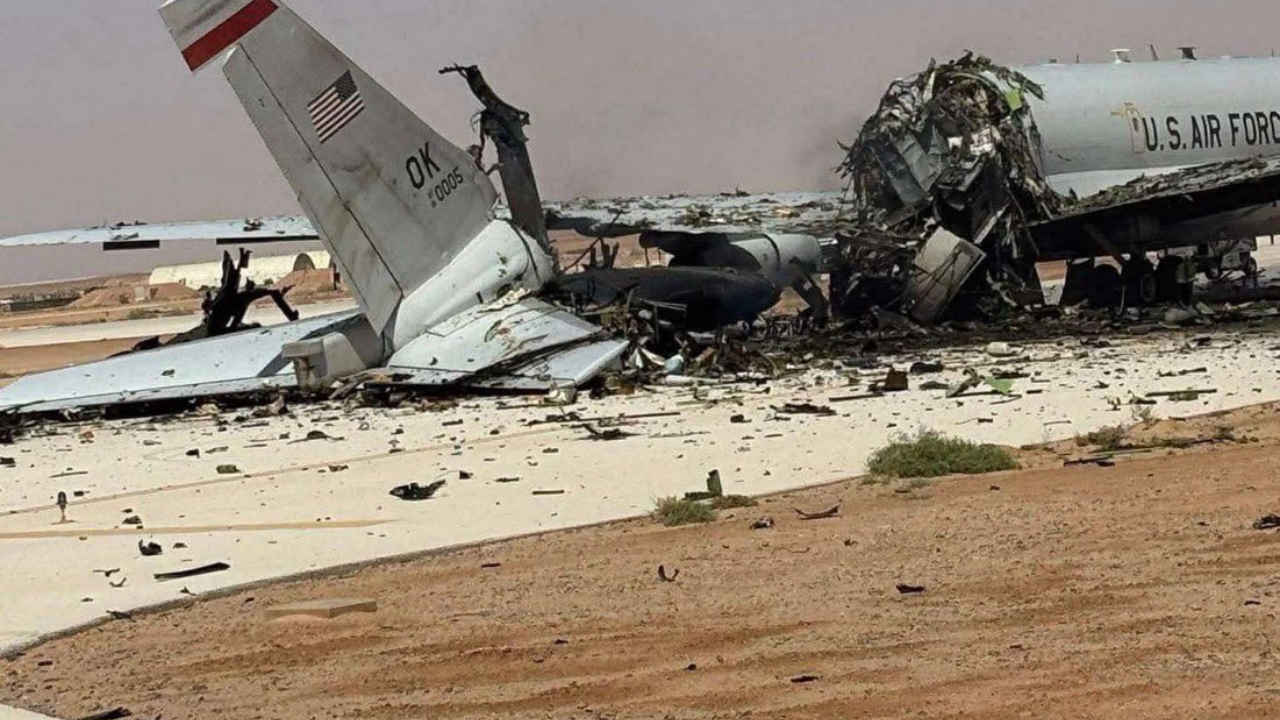
The recent strike on a U.S. E-3 Sentry Airborne Warning and Control System (AWACS) is not just another headline in a long string of Middle Eastern skirmishes. It represents a fundamental shift in the regional balance of power. For decades, the United States has relied on its “eyes in the sky” to maintain absolute air supremacy. That veil of invincibility has been pierced. When an E-3 Sentry goes down, it is not merely the loss of an airframe; it is the loss of a command center, a massive tactical advantage, and a piece of history that cannot be rebuilt.
A Fleet on the Brink of Extinction
To understand why this single event is so catastrophic, one must look at the numbers. The U.S. Air Force does not have hundreds of these planes sitting in hangars. After years of budget cuts and retirements, the total active fleet of E-3 Sentries has dwindled to roughly 17 aircraft. These are the workhorses of every major conflict, providing the long range radar and communication relay needed for modern warfare.
When you lose one aircraft out of 17, you aren’t just losing a plane. You are losing a massive percentage of your global capability. Currently, six of these aircraft were deployed to the Gulf region. That represented nearly 40 percent of the entire American inventory concentrated in one theater. With one plane destroyed, the “rotation” of crews and maintenance becomes nearly impossible to sustain over a long period. The stress on the remaining five aircraft will be immense, likely leading to more mechanical failures and gaps in coverage.
The Brain of the Air War
The E-3 Sentry is easily recognizable by the massive rotating radar dome perched atop its fuselage. This dome allows the crew inside to see aircraft, cruise missiles, and even small drones from hundreds of kilometers away. While fighter jets have their own radars, they are limited by their size and the curvature of the earth. The E-3 flies high enough to look down over the horizon, spotting threats long before they can reach friendly forces.
Beyond just seeing the enemy, the E-3 acts as the quarterback of the sky. The controllers on board manage hundreds of targets at once. They tell fighter pilots where to go, notify tankers where they are needed for refueling, and coordinate with ground based air defenses like the Patriot and THAAD systems. Without the Sentry, the air war becomes a series of disjointed, chaotic dogfights rather than a synchronized symphony of military precision.
Shadows of External Support
One of the most concerning aspects of this strike is the technical proficiency required to pull it off. The E-3 Sentry does not fly near the front lines. It operates deep within friendly or protected airspace, usually surrounded by a “high value airborne asset” (HVAA) protection cap of fighter jets. For Iran to successfully target and hit such a prize suggests they had help.
Military analysts widely believe that Russian intelligence may have provided the specific tracking data or electronic warfare support needed to bypass the Sentry’s defensive suites. If Iran is now capable of reaching out and touching the “untouchable” assets of the U.S. military, it means no base or aircraft in the region is truly safe. This strike also confirms that these planes were operating out of Prince Sultan Air Base in Saudi Arabia. As U.S. options for staging bases shrink due to political pressure and Iranian missile reach, the remaining hubs become predictable and vulnerable targets.
Systematic Dismantling of the Sensor Layer
This was not a random act of aggression. It appears to be part of a calculated Iranian strategy to “blind” the U.S. and its allies. Before the strike on the E-3, several other radar systems and THAAD (Terminal High Altitude Area Defense) components were targeted across the Gulf.
By systematically removing the sensors that form the backbone of missile defense, Iran is clearing a path for its own ballistic missiles and drone swarms. If the U.S. cannot see the threats coming, it cannot intercept them. Striking the AWACS is the crown jewel of this strategy. It forces the U.S. to fly its fighter jets more often just to maintain a basic level of situational awareness, which wears out engines and exhausts pilots.
The Psychology of an Empty Sky
There is a significant psychological component to this loss. The AWACS has long been a symbol of American technological dominance. It represents the “High Ground.” Seeing one of these giants brought down is a massive blow to morale and a huge public relations win for Tehran.
Historically, these aircraft have operated with a sense of near-total security. They are the protected assets that everyone else dies to defend. Now that this aura of safety is gone, every pilot flying a tanker or a transport plane in the region has to wonder if they are next. It erodes the confidence of regional allies who rely on the American “security umbrella” to keep their own borders safe.
A Ghost from the Past with No Future
The most practical problem facing the U.S. military right now is that the E-3 Sentry is a dinosaur. It is based on the Boeing 707 airframe, a commercial jet design that first flew in the 1950s. Boeing stopped producing the 707 decades ago. There is no factory to call for a replacement. There is no “spare” airframe sitting in a warehouse that can be easily converted.
Every time an E-3 is lost, it is a permanent reduction in the strength of the United States. While the crews are elite and the electronics inside have been updated over the years, the “bones” of the plane are old. Maintenance is already a nightmare, with parts often being scavenged from museum pieces or “boneyards” in the desert. You cannot simply “buy” your way out of this loss.
The Wedgetail Waiting Game
The U.S. does have a plan for a successor, known as the E-7 Wedgetail. This newer aircraft is based on the modern Boeing 737 and features a more advanced, stationary radar. However, the E-7 program has been caught in a web of political delays, budget debates, and slow production timelines.
As it stands, the U.S. does not have a fleet of E-7s ready to take over. It will be years before the Wedgetail is available in numbers that matter. This leaves a “capability gap” that is now being exploited. Iran has realized that the U.S. is at its most vulnerable point in decades, stuck between an aging fleet it cannot replace and a new fleet that hasn’t arrived yet.
A New Reality for Gulf Operations
The destruction of the E-3 Sentry signals the end of the era where the U.S. could operate with impunity. The “reach” demonstrated by Iran means that even the most sophisticated electronic warfare platforms are at risk. Moving forward, the U.S. will likely have to pull its remaining assets further back, which reduces their radar effectiveness and increases the time it takes to respond to threats.
This single strike has forced a total re evaluation of how air power is projected in the Middle East. It has exposed the fragility of a fleet that is too small, too old, and too difficult to replace. In the game of high stakes military chess, Iran didn’t just take a pawn; they took a queen.
Leave a Reply