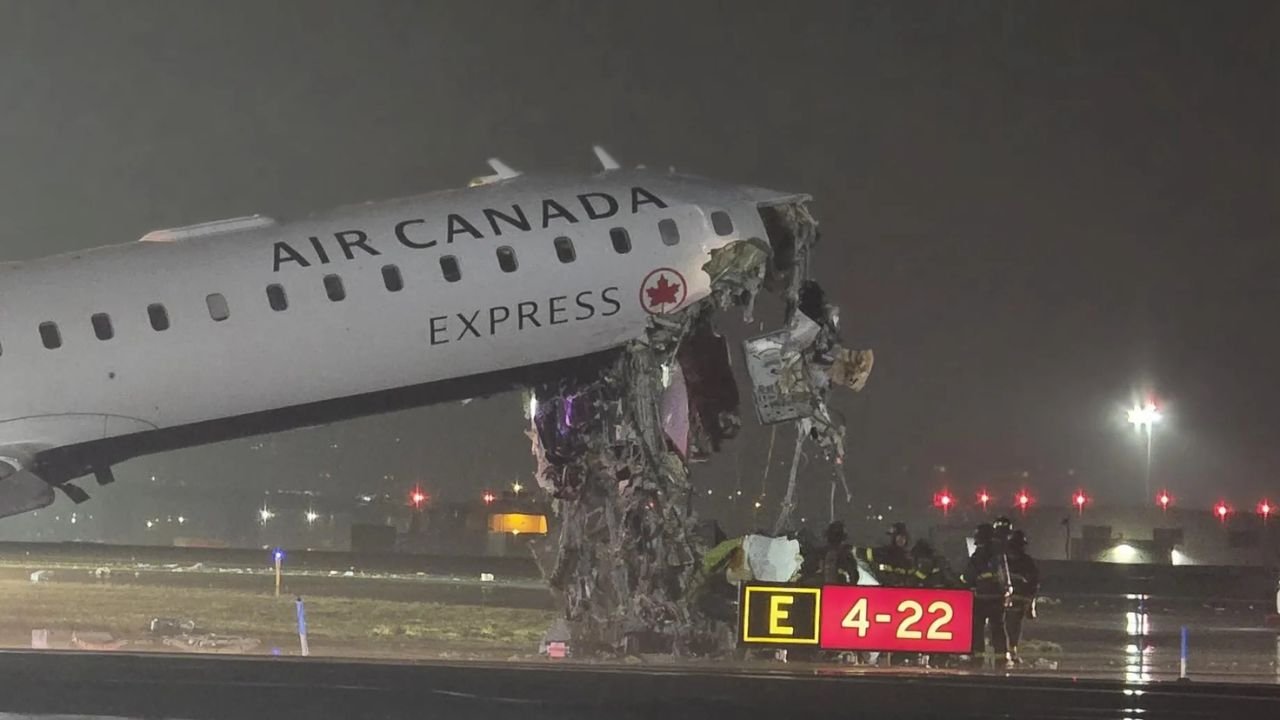
The aviation world is mourning today following a devastating ground collision at New York’s LaGuardia Airport involving Air Canada Express Flight 8646. Late Sunday night, March 22, 2026, the Bombardier CRJ-900, arriving from Montreal, struck a Port Authority fire truck on the runway. The impact was catastrophic, claiming the lives of both pilots and leaving dozens of passengers with various injuries. As the investigation begins, Air Canada President and CEO Michael Rousseau has addressed the public, offering a somber update on the tragedy and the airline’s immediate response.
A Somber Day for the Aviation Community
In a heartfelt video statement released on social media, Michael Rousseau did not mince words about the gravity of the situation. He began by acknowledging the emotional weight felt across the entire company. “Today is a very somber day at Air Canada,” Rousseau stated. He went on to express the company’s collective grief, saying, “First, and most importantly, I want to express our deepest sorrow for everyone affected. Our efforts are focused on the needs of our passengers and crew members, along with their families and loved ones.”
The accident has sent shockwaves through the industry, particularly because ground collisions of this magnitude at major hubs are exceedingly rare. Rousseau emphasized that while the aircraft was operated by Jazz Aviation LP under the Air Canada Express banner, the loss is felt as one large family. He noted that the company is “deeply saddened by the loss of two Jazz employees,” and extended condolences to the “entire Jazz community and their families.”
Details of the Fatal Collision at LaGuardia
Flight AC8646 originated from Montreal-Trudeau International Airport (YUL) with 72 passengers and four crew members on board. The flight was reportedly routine until the final moments of its landing at LaGuardia (LGA) at approximately 11:38 PM. As the jet decelerated on Runway 4, it collided with a Port Authority Aircraft Rescue and Fire Fighting (ARFF) vehicle.
The impact was centered on the front of the aircraft, effectively destroying the cockpit and forward galley. Images from the scene showed the plane’s nose tilted upward with mangled metal and cables dangling from the fuselage. The fire truck, an Oshkosh Striker 1500, was found overturned on its side nearby. While the two Port Authority personnel inside the truck survived with stable injuries, the outcome for the flight deck was far more grim.
Remembering the Fallen Crew Members
The most painful aspect of this tragedy is the loss of the two pilots who were at the controls. Rousseau confirmed the deaths in his statement, saying, “We now know that the captain and the first officer were killed in this accident.” One of the pilots has been identified as 30-year-old Antoine Forest from Coteau-du-Lac, Quebec.
Survivor accounts suggest that the pilots may have performed heroically in their final seconds. One passenger, Clément Lelièvre, recounted how the pilots braked with extreme force immediately upon touchdown. Many on board believe these “incredible reflexes” likely slowed the aircraft enough to prevent even more fatalities among the 72 passengers in the cabin. Despite the terrifying jolt and the destruction of the front of the plane, all 72 passengers survived, though about 40 required hospital treatment for various injuries, ranging from broken noses to severe fractures.
Critical Breakdown in Communication
The focus of the investigation has quickly shifted toward a potential failure in air traffic control (ATC) protocols. Audio recordings from the night of the crash provide a chilling look at the moments leading up to the impact. In the tapes, a controller is heard clearing the fire truck, known as “Truck 1,” to cross Runway 4. The truck was reportedly responding to a separate, minor emergency involving a United Airlines flight that had reported a strange odor.
Seconds later, the tone of the recording shifts to pure panic. The controller can be heard shouting, “Stop Truck 1! Stop, stop, stop!” followed by a frantic attempt to wave off another incoming aircraft. In a haunting admission captured shortly after the crash, the same controller was heard saying, “I messed up.” The National Transportation Safety Board (NTSB) and Canadian authorities are now working to determine how a vehicle was permitted to enter an active runway while a passenger jet was in the final stages of its landing roll.
Immediate Support for Families and Survivors
Air Canada has moved quickly to provide resources for those impacted by the crash. Rousseau mentioned that the Air Canada Special Assistance Team was activated immediately. “Members of our specialized team will be on their way to New York,” he said, adding that “anything we can do now, we’re doing.”
The airline has established a dedicated family assistance hotline at 1-800-961-7099 for those seeking information about loved ones who were on board. Rousseau urged the public to rely on official channels for updates, promising that information would be shared as soon as it is verified by authorities.
The Path Forward and the NTSB Investigation
The investigation into Flight AC8646 is expected to be lengthy and thorough. Investigators from the NTSB have already begun walking the scene, and flight recorders have been recovered from the wreckage. They will be looking at everything from airport lighting and weather conditions to the mental state and staffing levels of the air traffic control tower. At the time of the accident, heavy rain was falling in the New York area, and visibility was limited to roughly three miles, which may have played a role in the visibility of the ground vehicle.
Furthermore, the accident occurred during a period of chronic air traffic controller shortages in the United States, a factor that safety advocates have been warning about for years. While the LaGuardia controllers were not affected by the ongoing partial government shutdown, the overall strain on the system will likely be a point of scrutiny.
Standing Together in Times of Crisis
As the aviation community processes this loss, the focus remains on the human element. The survival of a flight attendant, Solange Tremblay, who was reportedly thrown from the aircraft while still buckled into her seat, has been described by her family as a “total miracle.” Such stories of survival sit in stark contrast to the silence of the cockpit, reminding everyone of the thin line between safety and tragedy in the skies.
Michael Rousseau closed his statement by reiterating the airline’s commitment to the investigation and to the people involved. “We’re fully supporting the relevant investigative authorities in their investigation to learn everything we can about these events,” he said. For now, the priority remains the care of the families who are dealing with unimaginable loss.
Leave a Reply