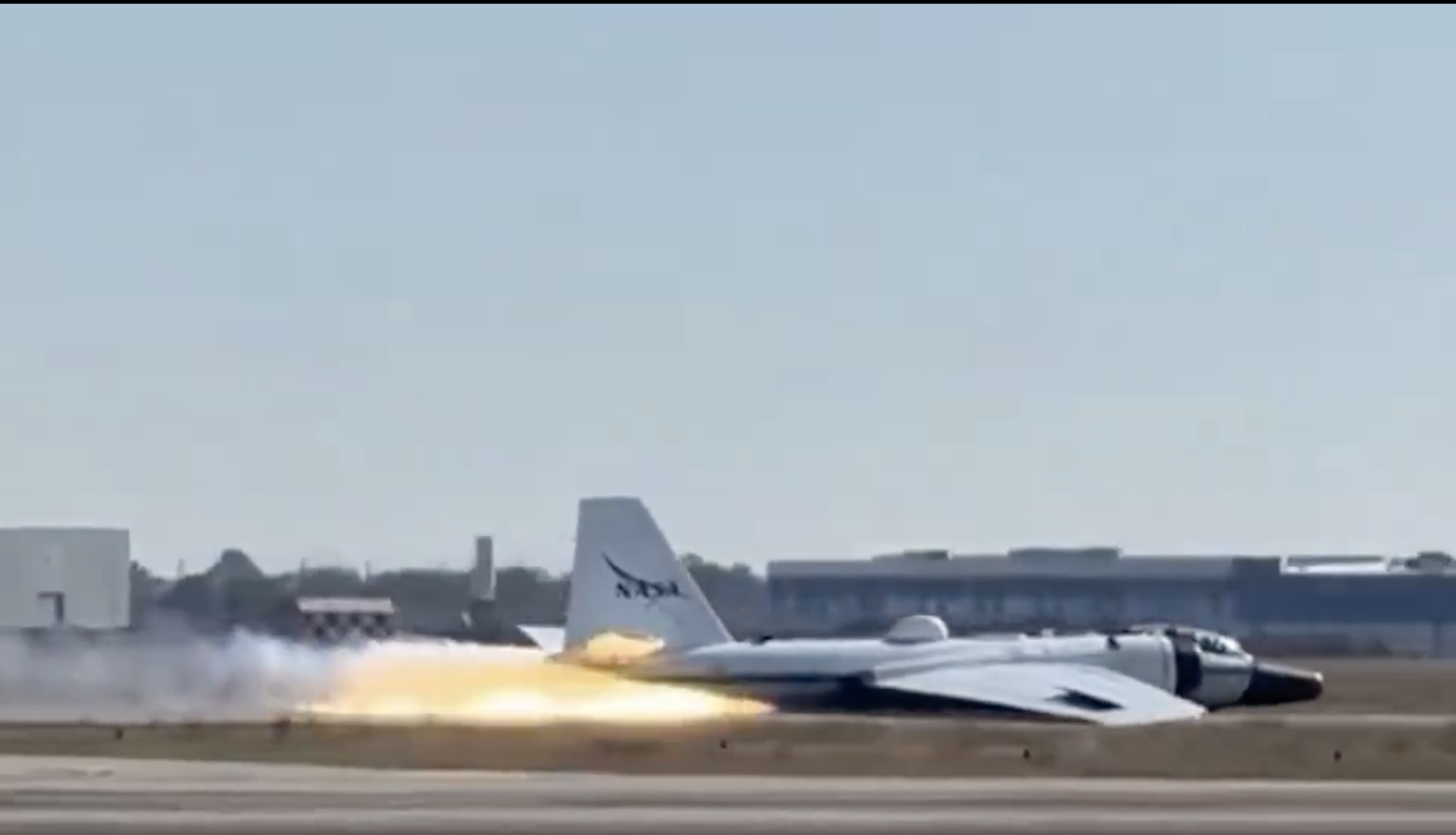
A NASA Plane used for research faced an emergency landing at Ellington Airport because its landing gear failed to operate after a mechanical malfunction. The video shows the plane landing on its belly which created sparks and flames and thick smoke that followed behind it as it moved down the runway. The dangerous situation ended in success when both crew members escaped without injuries.
The incident captured immediate public interest because of its visual strength and because NASA aircraft emergency landings happen so infrequently. The officials proved that they managed the terrifying situation through their safe and effective professional procedures.
Landing Gear Failure Triggers Belly Landing
The aircraft involved was a NASA WB-57, a high-altitude research plane that has supported scientific missions for decades. During its approach to Ellington Airport, the crew discovered that the landing gear would not deploy due to a mechanical malfunction.
With limited options available, the pilots prepared for a controlled belly landing. Emergency crews were placed on standby along the runway as the aircraft lined up for touchdown. Such landings require precise control and careful coordination, especially in a plane designed for high-altitude research rather than commercial transport.
Dramatic Video Of The Nasa Plane Shows Sparks and Flames
Footage shared online captures the moment the NASA plane made contact with the runway. As the fuselage scraped along the pavement, sparks shot behind the aircraft and bright yellow flames flared underneath. Thick smoke quickly followed, while the wings visibly bounced on impact.
The dramatic visuals sparked widespread reaction on social media, with many viewers expressing concern before learning that both crew members escaped unharmed.
Crew Remains Calm and Exits Safely
NASA officials praised the crew for maintaining control throughout the emergency landing. The aircraft eventually came to a complete stop as emergency responders rushed to the scene.
Both crew members exited the NASA plane on their own and refused medical treatment, confirming they were not injured. Their safe escape underscored the importance of training and preparedness when dealing with unexpected mechanical failures.
NASA WB-57 Aircraft Has Long Research History
The WB-57 has been used for decades in high-altitude scientific research, including atmospheric studies and support for space-related missions. Its ability to operate at extreme altitudes makes it a valuable tool for NASA’s research programs.
Incidents involving this aircraft are rare, making the emergency landing especially notable. NASA emphasized that the plane’s strong design and the crew’s experience played key roles in the successful outcome.
Investigation Underway Into Mechanical Issue
NASA confirmed that the landing gear malfunction will be fully investigated. Engineers will examine the aircraft to determine the exact cause of the failure and assess any damage sustained during the landing.
Ellington Airport operations were temporarily affected as emergency crews secured the area and safety inspections were completed. Officials later confirmed that the situation was contained without further incident.
A Reminder of Aviation Risk and Training
While belly landings appear dangerous, aviation experts note they are often survivable when executed properly. Aircraft are designed with reinforced fuselages, and pilots regularly train for emergency scenarios.
The NASA plane emergency landing in Texas highlights both the risks involved in aviation and the effectiveness of preparation under pressure. In the end, the most important outcome was clear, a dramatic incident that resulted in no injuries.
Leave a Reply