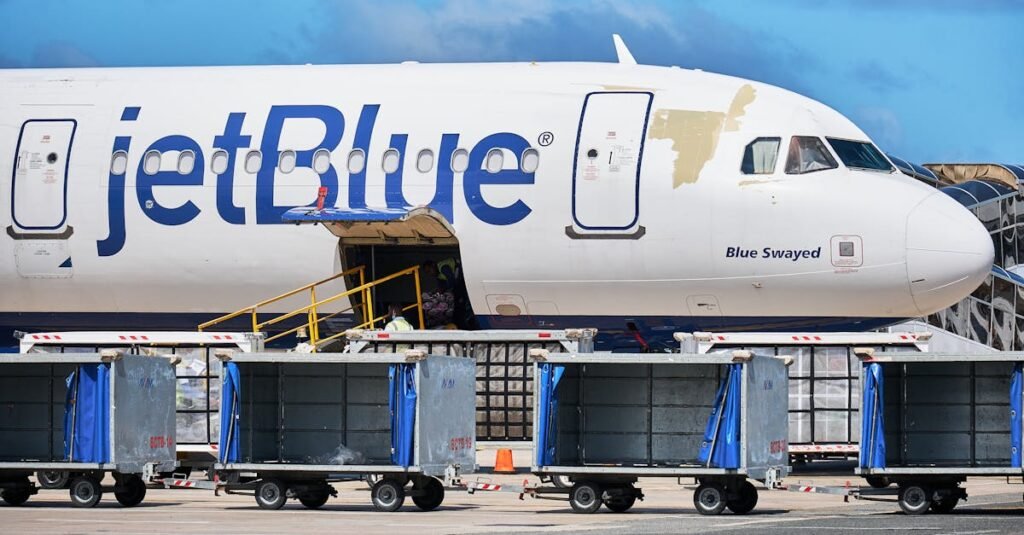
On Wednesday, February 18, 2026, Newark Liberty International Airport (EWR) was abruptly brought to a standstill.Thousands of travelers were left scanning departure boards in confusion as a “ground stop” was declared, effectively freezing one of the busiest aviation hubs in the United States. The cause? A harrowing emergency involving JetBlue Flight 543, an Airbus A320 bound for West Palm Beach, Florida.+2
What began as a routine evening departure quickly escalated into a high-stakes emergency landing, cockpit smoke, and a full-scale tarmac evacuation that forced federal authorities to shutter the entire airport.
The Timeline of JetBlue Flight 543: 40 Minutes of Uncertainty
JetBlue Flight 543 was scheduled for a standard sunset departure, lifting off from Newark at approximately 5:43 PM local time. However, the flight didn’t make it far. Within minutes of reaching its initial climb, the flight crew detected a catastrophic failure in engine number one.+1
While modern twin-engine aircraft are designed to fly perfectly well on a single engine, the situation grew more complex when smoke began to filter into the cockpit and the passenger cabin. Recognizing the immediate threat to the crew’s visibility and passenger safety, the pilots declared an emergency and requested an immediate return to Newark.+1
The aircraft spent only about 17 to 20 minutes in the air, performing a tight loop over northern New Jersey before touching down safely on the runway just after 6:00 PM.
The Tarmac Crisis: Why the Airport Had to Close
Many travelers wonder why a single plane’s mechanical issue would necessitate the shutdown of an entire international airport. The answer lies in the emergency evacuation protocols.
After landing, the crew of Flight 543 determined that the smoke levels were significant enough that they could not risk taxiing the aircraft all the way back to the gate. The pilots brought the Airbus A320 to a halt on a taxiway and made the critical call to “pull the chutes.”
- Evacuation via Slides: All 122 passengers and crew members were forced to exit the aircraft via inflatable emergency slides directly onto the tarmac.
- Total Ground Stop: Per FAA and Port Authority safety regulations, whenever passengers are on the actual airfield (outside of the aircraft and not in a vehicle), all aircraft movement must cease. This prevents any risk of an evacuating passenger being struck by a taxiing plane or sucked into a nearby engine.
- Emergency Responder Influx: Dozens of fire trucks, ambulances, and Port Authority police vehicles swarmed the taxiway, further blocking the “lanes” used by other flights.
The Anatomy of an Engine Failure: What Went Wrong?
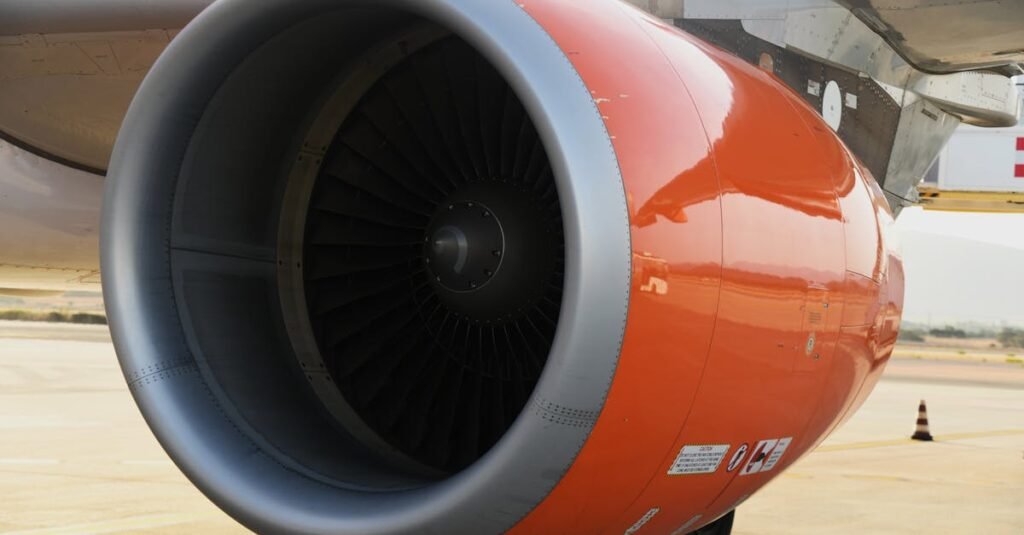
While the official investigation by the Federal Aviation Administration (FAA) and the National Transportation Safety Board (NTSB) is ongoing, preliminary reports point toward a mechanical breach in the #1 engine.
Why was there smoke in the cabin?
In an aircraft, the air you breathe is “bleed air” drawn from the engines. If an engine suffers a mechanical failure involving an oil leak or a seal breach, atomized oil or hydraulic fluid can enter the air cycle machine. When this fluid hits the high-heat environment of the engine, it vaporizes, creating a thick, acrid smoke that is pumped directly into the cockpit and passenger cabin.
Passenger Accounts: “A Calm but Tense Scene”
Social media was quickly flooded with footage from the tarmac. Passengers described a distinct smell of burning plastic or chemicals followed by a visible haze in the cabin. Despite the terrifying nature of an emergency evacuation, eyewitnesses praised the JetBlue flight attendants for their professional handling of the 122 souls on board.
One passenger, Alexandra Svokos, recounted the speed of the event, noting that once the slides were deployed, the plane was empty in under two minutes. Emergency medical teams evaluated one passenger for chest pains, but remarkably, no traumatic injuries were reported during the slide descent a testament to the effectiveness of modern aviation safety drills.
The Ripple Effect: Newark’s Operations and Air Traffic Control
Newark Liberty is a notoriously “compact” airport. Unlike sprawling facilities like Denver or Dallas-Fort Worth, Newark’s runways and taxiways are tightly packed. When Flight 543 came to a halt on a primary taxiway, it effectively acted as a cork in a bottle.
- Delayed Flights: According to FlightAware data, approximately 31% of arrivals and 30% of departures were delayed.
- Diverted Aircraft: Planes already in the air heading for Newark were forced to circle in “holding patterns” or divert to Philadelphia (PHL) and New York-JFK.
- The Reopening: The ground stop remained in effect until roughly 7:00 PM, when the aircraft was finally towed to a maintenance hangar and the taxiway was cleared of debris and passengers.
Safety First: The FAA and JetBlue’s Response
In a statement released shortly after the incident, JetBlue reiterated its commitment to safety:
“Safety is JetBlue’s top priority. We are focused on supporting our customers and crew members and will work closely with the appropriate federal authorities to investigate what occurred.”
The FAA has confirmed that it will be performing a deep dive into the maintenance records of the specific Airbus A320 involved. Investigators will look for signs of metal fatigue, bird strikes (though none were initially reported), or component failure within the turbine assembly.
Beyond the Chaos: Why Flight 543 is a Masterclass in Aviation Safety
While a total shutdown of a major international hub like Newark Liberty is often viewed through the lens of frustration and missed connections, the resolution of JetBlue Flight 543 represents a triumph of modern aviation protocols. In the high-stakes environment of a cockpit filled with smoke, seconds are the only currency that matters. The decision-making process displayed by the flight crew transitioning from a standard climb to an emergency descent and a full-scale tarmac evacuation in under 40 minutes is a testament to the rigorous, simulator-driven training that defines the industry today.
The “ground stop” that paralyzed the Tri-State area’s air traffic was not a failure of the system, but rather the system working exactly as designed. By freezing all movement at EWR, the FAA and Port Authority created a “sterile environment,” ensuring that the 122 passengers sliding onto the pavement were protected from the secondary risks of a functioning airfield. In the world of commercial flight, an “inconvenience” for thousands is always a fair trade for the lives of a few hundred.
As investigators from the NTSB begin their “tear-down” of the failed engine to identify the root mechanical cause, the takeaway for the traveling public is one of resilience. This incident serves as a visceral reminder that while mechanical failures are an inherent risk of complex machinery, the layers of redundancy both in the aircraft’s engineering and the crew’s emergency procedures are robust enough to turn a mid-air crisis into a safe landing. For the passengers who walked away on the Newark tarmac on Wednesday night, the smell of smoke and the rush of the inflatable slide will be a lifelong memory, but thanks to a “safety-first” culture, it is a memory they are alive to share.