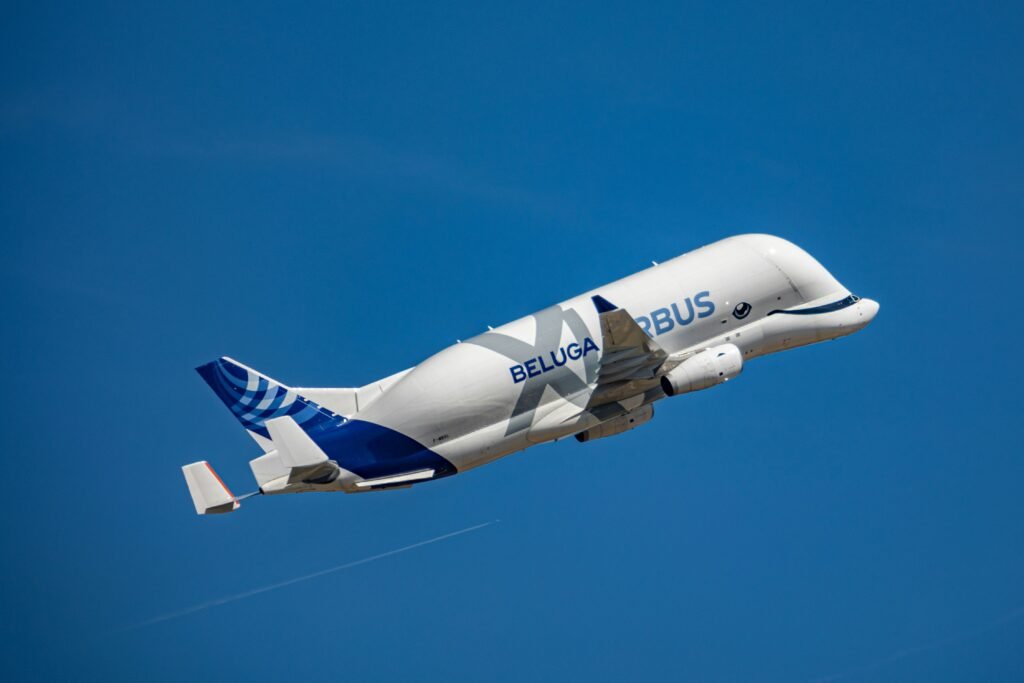
On January 29, 2026, aviation enthusiasts and Airbus teams alike witnessed an emotional moment in aerospace history. The beloved Airbus Beluga ST, one of the most recognizable and unusual aircraft ever to grace the skies completed its final flight before retirement. After decades of service, the distinctive “whale of the skies” touched down at Hawarden (Broughton) Airfield in North Wales, marking the end of a remarkable chapter in European aviation.
This final sortie wasn’t just another landing; it was a salute to an aircraft that had quietly shaped how modern aircraft are produced. Crowds gathered to watch the Beluga ST’s farewell flypast, capturing footage that spread quickly across social platforms.
Why the Airbus Beluga ST Was Built: A Logistics Revolution
Airbus did not have an easy challenge in the early 1990s. Its factories were spread across multiple European countries — with wings built in the UK, fuselage sections in Germany, nose sections in France, and final assembly in Toulouse, France, or Hamburg, Germany. Transporting large, delicate aircraft components between these sites by road or rail was time-consuming and inefficient.
Before the Beluga, Airbus relied on converted 1940s-era cargo planes called Super Guppies to ferry oversized parts. These quirky aircraft had done heroic service but were costly to operate and limited in capacity. Airbus recognised that a modern, larger aircraft was essential to support growing production demands. The solution was the bespoke A300-600ST Super Transporter, later nicknamed the Beluga for its striking resemblance to the white whale.
From Maiden Flight to Production Essential
Construction of the first Beluga ST began in September 1992, and the aircraft made its maiden flight on September 13, 1994. Following around 400 hours of rigorous testing, it was certified and ready for service by late 1995. Airbus built a total of five Beluga ST aircraft, each one taking roughly three years to complete from start to finish.
The Airbus Beluga ST became indispensable to Airbus’s logistics network. Its cavernous cargo bay could carry oversized parts, such as fuselage sections and wings, that would simply not fit into standard freighter aircraft. It flew regularly between Airbus production hubs across Europe, with some estimates suggesting up to 60 flights a week during peak periods.
Iconic Missions Beyond Airbus
Although designed primarily for internal logistics, the Beluga ST’s capabilities were quickly recognised for special missions. Over the years, it transported large artwork, industrial machinery, complete helicopters, and even satellite parts. These unique flights showcased the aircraft’s unmatched ability to handle outsized and irregular cargo.
The Arrival of the BelugaXL and the Transition
By the early 2010s, Airbus’s production needs had expanded beyond what the original Beluga ST fleet could efficiently serve. Antonio challenges, such as transporting the larger components of newer aircraft like the A350, demanded greater capacity. In response, Airbus launched the BelugaXL programme in 2014.
Based on the larger A330-200 airframe, the BelugaXL offers approximately 30% more cargo capacity than its predecessor. It features a redesigned fuselage and modernised systems, enabling it to carry larger parts, including two A350 wings at once — something the Beluga ST could not do. By mid-2024, the BelugaXL fleet was complete and fully operational, taking over the Super Transporter’s role in supporting Airbus’s manufacturing logistics.
A Lasting Legacy
With Airbus’s transition to a newer fleet, the original Beluga STs have gradually been retired. The aircraft that completed its final flight on January 29 with registration F-GSTF has now joined the growing list of retired Beluga STs stored or preserved.
But Airbus isn’t ready to let these icons fade quietly. The company is exploring ways to place the retired Beluga ST aircraft in museums, educational displays, and public exhibitions. These placements would allow future generations to appreciate the engineering ingenuity and logistical impact of these extraordinary machines.
Airbus penned a tribute on social media and wrote:
What This Means for Aviation
The Airbus Beluga ST may no longer be needed in day-to-day operations, but its legacy continues. It represents a pivotal innovation in aerospace logistics, a tailor-made solution that enabled Airbus to streamline production and compete on the global stage. As a trailblazer in its role, it earned its place not only on airshow flight lines and enthusiast calendars but also in aviation history.