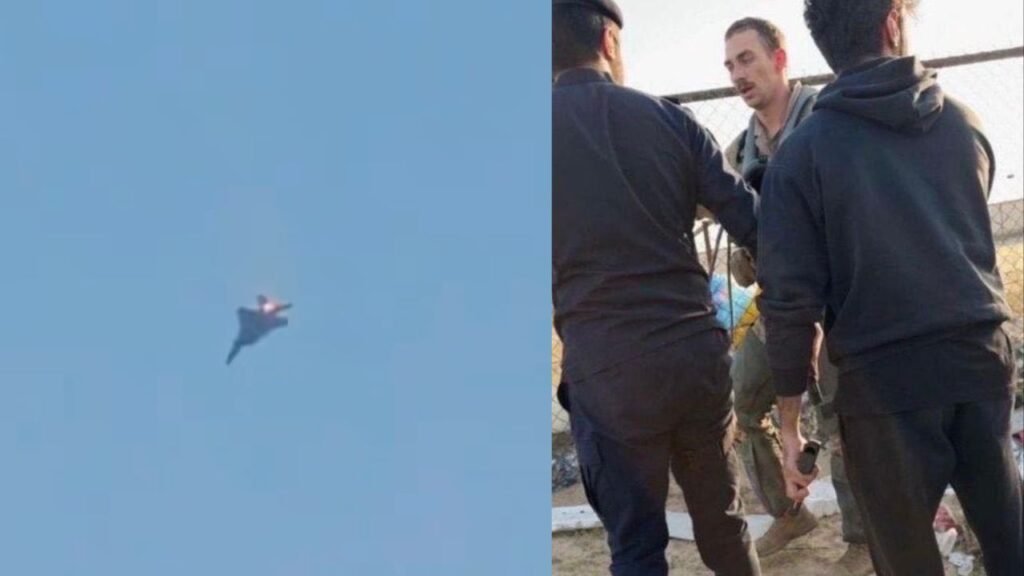
A high performance U.S. Air Force F-15E Strike Eagle went down in Kuwait on Monday morning, marking a significant loss of coalition hardware during a period of extreme regional volatility. The incident occurred as the broader conflict between the United States and Iran entered its third day of intensive operations. While the sight of a multi-million dollar fighter jet spiraling toward the desert floor is jarring, the focus remains on the survival of the crew and the murky circumstances that led to the crash.
Immediate Condition of the Pilot and WSO
The most critical update involves the two crew members on board: the Pilot and the Weapons Systems Officer (WSO).Reports from the Kuwaiti Ministry of Defense and local eyewitnesses confirm that both individuals successfully initiated their ejection sequence before the aircraft impacted the ground.
Video footage circulating on social media platforms shows at least one parachute drifting toward the desert terrain west of Al Jahra. In a rare show of civilian involvement during active hostilities, local Kuwaiti residents were among the first to reach the downed airmen. Clips show the crew being assisted by bystanders and placed into a civilian vehicle for transport to a safe location.
The Kuwaiti military has since confirmed that the airmen are in stable condition. They were moved to a local medical facility for evaluation, suffering from what appear to be minor injuries consistent with the physical toll of a high speed ejection.
Geographic Details of the Crash Site
The F-15E, a mainstay of American air power, reportedly went down in western Kuwait, with some analysts pinpointing the coordinates near the Khor Abdullah waterway close to the Iraqi border. This region is currently a high traffic corridor for coalition aircraft moving toward targets in the east.
Debris from the stricken jet did not just land in empty sand. Fragments of the aircraft reportedly fell within the perimeter of the Mina Al Ahmadi refinery, a vital piece of Kuwaiti infrastructure operated by the Kuwait Integrated Petroleum Industries Company (KIPIC). Early reports indicate that two refinery workers sustained minor injuries from falling debris, though the facility itself remains operational under heightened security protocols.
The Mystery of the Cause: Friendly Fire or Mechanical Failure?
The most controversial aspect of this incident is the “why.” While the Pentagon has yet to release a formal accident investigation report, several theories are gaining traction among defense analysts and on the ground observers.
- The Friendly Fire Theory: There is significant speculation that the Strike Eagle was mistakenly targeted by a Patriot air defense battery. In the chaotic, “target rich” environment of the current Gulf conflict, where hundreds of Iranian drones and missiles are being intercepted simultaneously, the risk of a technical glitch in the Identification Friend or Foe (IFF) system is at its highest.
- Iranian Engagement: State media in Tehran has been quick to claim credit for the downing, releasing footage they allege shows the aircraft being struck. However, U.S. officials have cautioned against taking these claims at face value, noting that the aircraft appeared to be in a flat spin with fire trailing from its empennage before the final descent.
- Catastrophic Mechanical Issues: Even without enemy action, the high tempo of combat operations puts immense strain on airframes. A dual engine failure or a flight control malfunction cannot be ruled out until the flight data recorders are recovered and analyzed.
Strategic Context of the Mission
This F-15E was reportedly part of the 335th Fighter Squadron, often identified by its distinctive “Chiefs” helmet markings. The squadron is known for its precision deep strike capabilities, which have been heavily utilized in the ongoing “Operation Epic Fury.”
At the time of the crash, the airspace over Kuwait was under a “shelter in place” order for U.S. personnel. The U.S.Embassy in Kuwait City had issued urgent warnings for citizens to stay indoors due to the continuous threat of incoming UAVs and ballistic missiles. The fact that several other U.S. military aircraft were reported as “crashed” or “downed” on the same morning suggests a massive, coordinated air defense struggle was occurring in the skies above the Gulf.
Technical Profile of the F-15E Strike Eagle
To understand the gravity of this loss, one must look at the aircraft itself. The Strike Eagle is not just a fighter; it is a dual role platform designed for long range, high speed interdiction without relying on escort aircraft.
- Crew: Two (Pilot and WSO)
- Engines: Two Pratt & Whitney F100-PW-220 or -229 turbofans with afterburners
- Role: All weather deep strike and air superiority
- Cost: Approximately $31 million to $50 million per unit, depending on the variant and avionics suite
The loss of even a single airframe represents a hit to the tactical depth of U.S. Central Command, especially when the crew is forced into a survival situation in a region where ground lines are rapidly shifting.
Current Tensions in the Kuwaiti Air Corridor
Kuwait has long served as a stable hub for American military logistics, but the events of March 2 have proven that no location in the region is truly “behind the lines” anymore. With drone strikes targeting the Kuwait International Airport and reports of explosions near the U.S. Embassy, the crash of the F-15E is a symptom of a much larger escalatory cycle.
The Kuwaiti Air Defense Force has been working overtime to intercept “hostile aerial targets” at dawn, according to their own Ministry of Defense. This high pressure environment creates a “fog of war” where split second decisions by radar operators can lead to tragic mistakes or heroic saves.
Looking Toward the Official Investigation
In the coming days, the United States Air Force will likely convene a formal Safety Investigation Board (SIB) and an Accident Investigation Board (AIB). These teams will look at everything from maintenance logs at the home base to the electronic signals recorded by the Patriot batteries in the vicinity.
The recovery of the wreckage from the refinery and the surrounding desert will be the first step. For now, the successful rescue of the crew remains the only bright spot in a morning defined by fire and falling metal.
Ongoing Recovery and Security Efforts
As the sun sets over the Kuwaiti desert, the area around Al Jahra remains cordoned off by security forces. The priority has shifted from rescue to recovery and intelligence protection. Military officials are working to ensure that sensitive technology within the Strike Eagle’s cockpit does not fall into the wrong hands.
The U.S. and Kuwaiti governments continue to coordinate closely. While the geopolitical ripples of this crash will be felt in Washington and Tehran, the immediate concern for the families of the Pilot and WSO is simply that they are safe,accounted for, and receiving the medical care they need after a harrowing morning in the sky.