Tag: Boeing

  • Boeing 777-9: Why This Simulator ‘Green Light’ is the Breakthrough the Program Desperately Needed

    Boeing 777-9: Why This Simulator ‘Green Light’ is the Breakthrough the Program Desperately Needed

    In the high-stakes chess game of global aerospace, Boeing has just made a move that many industry insiders believe could be the most significant turning point for the 777X program in years.

    On February 19, 2026, the aviation giant announced it had received initial qualification from both the Federal Aviation Administration (FAA) and the European Union Aviation Safety Agency (EASA) for its 777-9 training devices. At first glance, a “simulator certificate” might seem like a dry, technical checkbox. However, for a program that has been haunted by half a decade of delays, billion-dollar charges, and regulatory skepticism, this “green light” is the structural support Boeing desperately needed to keep its 2027 delivery promises.

    Beyond the Cockpit: Why This Qualification Matters Now

    The Boeing 777-9 is not just another airplane; it is a massive technological leap designed to be the world’s largest and most efficient twin-engine jet. But with great innovation comes great regulatory scrutiny. Since the grounding of the 737 MAX years ago, the “trust gap” between Boeing and global regulators has made the certification of the 777X one of the most difficult processes in aviation history.

    Securing initial qualification for the training devices means that the FAA and EASA have formally agreed that the digital representation of the 777-9 is accurate enough to train human beings. It signals that the aircraft’s flight laws, systems logic, and handling characteristics have reached a level of design stability. You cannot train a pilot on a “moving target”; the fact that regulators have put their stamp on these simulators suggests that the final version of the actual aircraft is finally coming into focus.

    The “Gatwick Gateway”: A Global Training Hub

    The qualified devices are currently housed at Boeing’s Training Campus in Gatwick, United Kingdom. Developed in a decade-long partnership with CAE, these aren’t just video games with fancy chairs. They are multi-million dollar “Full-Flight Simulators” (FFS) that use gaming-engine-powered visuals (specifically Epic Games’ Unreal Engine) to replicate every vibration, cloud, and mechanical quirk a pilot might encounter.+2

    Solving the “Pilot Bottleneck” Before it Starts

    One of the biggest risks for any new aircraft launch is “Operational Readiness.” An airline can have ten brand-new jets sitting on the tarmac, but they are expensive lawn ornaments if there are no certified pilots to fly them.

    By qualifying the simulators now roughly a year before the first expected deliveries to launch customer Lufthansa Boeing has successfully decoupled the pilot training timeline from the final aircraft certification timeline.

    • Validation of Courseware: Regulators will now use these sims to “test the test.” They will ensure the training manuals and procedures are safe before pilots ever step inside.
    • Instructor Preparation: Lead pilots from airlines like Emirates, Qatar Airways, and Cathay Pacific can begin their instructor training, ensuring a “train-the-trainer” effect is in place by 2027.
    • Reduced Risk for Airlines: This move allows airlines to plan their crew rosters with precision, removing a massive variable from their multi-billion-dollar fleet strategies.

    Inside the 777-9 Flight Deck: What’s New?

    The qualification of these devices is particularly vital because the 777-9 introduces features that have never existed in a commercial widebody before. The simulator allows pilots to master these innovations in a zero-risk environment:

    1. The Folding Wingtip Controls

    The 777X’s signature feature is its massive carbon-fiber wing with folding tips. This allows the giant to fit into standard airport gates designed for smaller planes. In the simulator, pilots must learn the specific logic of the folding mechanism—ensuring the tips are extended and locked before takeoff and folded immediately after landing.+1

    2. Touchscreen Avionics

    Following the lead of the 787 Dreamliner but taking it a step further, the 777-9 features large-format touchscreen displays. Pilots must build “muscle memory” for navigating these menus during high-pressure situations, such as engine failures or severe weather diversions.

    3. Dual Head-Up Displays (HUD)

    While many modern planes have a HUD for the captain, the 777-9 offers an option for both the pilot and co-pilot to have “eyes-out” data projection. Mastering the coordination between two pilots using HUDs requires specific, high-fidelity simulator hours.

    The Financial Stakes: Stopping the Bleeding

    To understand why this is a “desperate” breakthrough, one only needs to look at Boeing’s balance sheet. The 777X program has already incurred over $15 billion in pre-tax charges. Every month the program is delayed, Boeing loses hundreds of millions in storage costs, labor, and potential penalty payments to frustrated customers.

    By hitting this simulator milestone, Boeing is signaling to the market and its investors that the program is finally moving out of the “developmental chaos” phase and into the “operational execution” phase. It provides a tangible counter-narrative to the headlines of cracks in engine thrust links or uncommanded pitch events that have plagued the program’s past.

    The Road to 2027: What Happens Next?

    While the simulator qualification is a victory, the 777-9 still has a “mountain of work” ahead (as Boeing CEO Kelly Ortberg recently noted). Here is the expected roadmap:

    1. First Production Flight (April 2026): Boeing is currently preparing the first “production-standard” 777X (destined for Lufthansa) for its first flight. This is a critical requirement for final FAA certification.
    2. Courseware Approval: Regulators will spend the coming months flying the Gatwick simulators to approve the specific curriculum pilots will use.
    3. Global Rollout: Beyond Gatwick, CAE is already installing simulators in Frankfurt (for Lufthansa) and Singapore (to serve the Asia-Pacific market).
    4. Type Certification (Late 2026): The final stamp of approval for the actual airplane to carry passengers.

    A New Chapter for the 777X
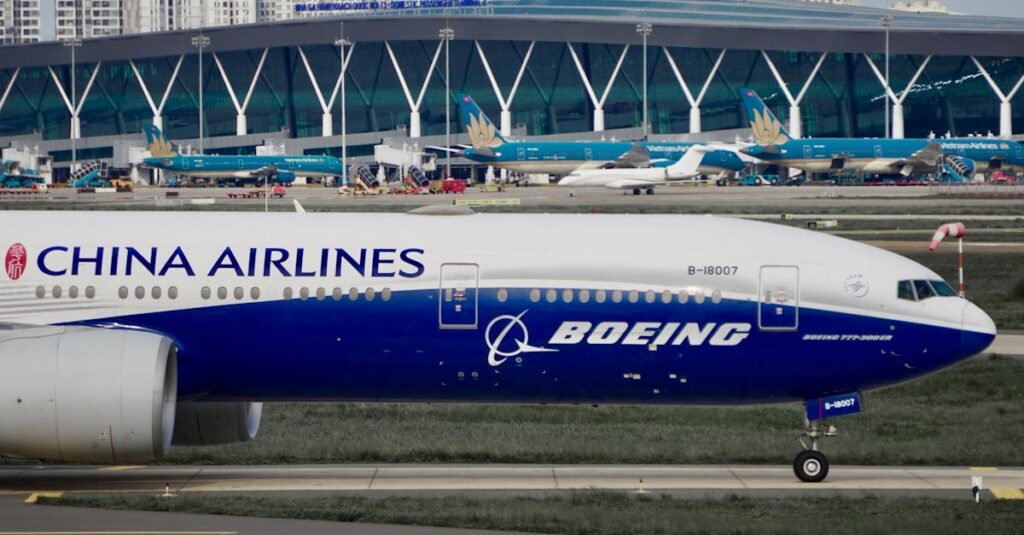
    Close-up of a Boeing 777 by China Airlines taxiing at an airport terminal.

    The “green light” for the 777-9 training devices is more than just a technical permit; it is a symbol of stability. It proves that the “digital twin” of the world’s most anticipated widebody is now a reality, even as the physical fleet continues its rigorous flight testing.

    For the pilots who will eventually command this folding-wing giant, the journey doesn’t start in the clouds it starts in a high-tech box in Gatwick. And for Boeing, that box might just be the most important tool they have to rebuild their reputation and finally deliver on the future of long-haul travel.
  • When Will Southwest Debut the Boeing 737 MAX 7? All We Know So Far

    When Will Southwest Debut the Boeing 737 MAX 7? All We Know So Far

    For nearly seven years, the aviation world and specifically Southwest Airlines has been playing a high-stakes game of “wait and see” with the Boeing 737 MAX 7. As the smallest member of the MAX family, the aircraft was originally intended to be the workhorse that would modernize Southwest’s short-haul fleet by 2019. However, a whirlwind of regulatory shifts, technical redesigns, and production hurdles has pushed that dream further down the runway.

    As of early 2026, the fog is finally beginning to lift. While the airline remains “optimistic,” the target for the official debut has moved to early 2027. This article dives deep into why the timeline shifted, the technical “fix” that saved the program, and what this means for the future of the world’s largest all-737 operator.

    The New Timeline: From Certification to Service

    To understand when you’ll actually step on board a Southwest MAX 7, we have to distinguish between “certification” and “entry into service.” They are not the same thing.

    2026: The Year of the FAA

    Southwest CEO Bob Jordan recently updated investors and analysts, stating that the airline now expects the Federal Aviation Administration (FAA) to grant the MAX 7 its type certification around August 2026. This follows a “rigorous testing” phase that Boeing has been conducting throughout late 2025 and the beginning of 2026.

    2027: The Passenger Debut

    Even if Boeing hands over the keys in late 2026, Southwest cannot simply start selling tickets. The airline requires a buffer of roughly six months to:

    • Train Pilots: Thousands of pilots must be familiarized with the specific nuances of the MAX 7 variant.
    • Maintenance Induction: Maintenance crews need to integrate the new airframe into their rigorous safety schedules.
    • Proving Runs: The airline must conduct its own non-passenger flights to satisfy operational requirements.

    Consequently, Southwest has officially adjusted its fleet planning to target Q1 2027 for the first commercial passenger flight of the Boeing 737 MAX 7.

    Why the Delay? The Engine Anti-Ice Hurdle

    The primary “roadblock” that haunted the MAX 7 for the last two years wasn’t the flight control software (MCAS) that grounded the fleet in 2019. Instead, it was a specialized hardware issue involving the Engine Anti-Ice (EAI) system.

    The Overheating Risk

    During the certification process, regulators discovered a potential flaw: under specific atmospheric conditions (dry, cold air), if a pilot left the engine anti-ice system on for too long, the heat could cause the carbon-composite engine inlets to overheat. This posed a structural risk to the engine housing.

    The Permanent Fix

    Boeing initially sought a temporary exemption to allow the plane to fly while they worked on a fix. However, following the high-profile door-plug incident on an Alaska Airlines flight in early 2024, the FAA and Boeing shifted to a “safety first” culture. Boeing withdrew the exemption request and spent 2025 engineering a permanent hardware redesign. This new system, completed in late 2025, is what is currently being flight-tested to ensure the MAX 7 meets the most modern safety standards.

    Southwest’s Pivot: The “MAX 8” Strategy

    Southwest is not just sitting idly by while Boeing works. To prevent a shortage of seats during the peak 2025 and 2026 travel seasons, the airline has had to get creative with its order book.

    In recent SEC filings (including the 10-K released in February 2026), Southwest revealed it has converted dozens of MAX 7 orders into the larger MAX 8.

    • The Benefit: It allows Southwest to continue growing its capacity and retiring its oldest aircraft.
    • The Trade-off: The MAX 8 is larger and carries more passengers (175 seats vs. 150 on the MAX 7). While great for high-traffic routes, it is less efficient for the “long and thin” routes that the MAX 7 was designed to dominate.

    How Will the “Baby Boeing” Impact Southwest

    Why is Southwest so committed to the MAX 7 despite nearly a decade of delays? The answer lies in the airline’s fundamental business model: point-to-point, high-efficiency travel.

    1. Replacing the 737-700

    Southwest still operates over 300 of the older Boeing 737-700s. These aircraft are the backbone of their fleet, but they are aging. The MAX 7 is the direct successor, offering:

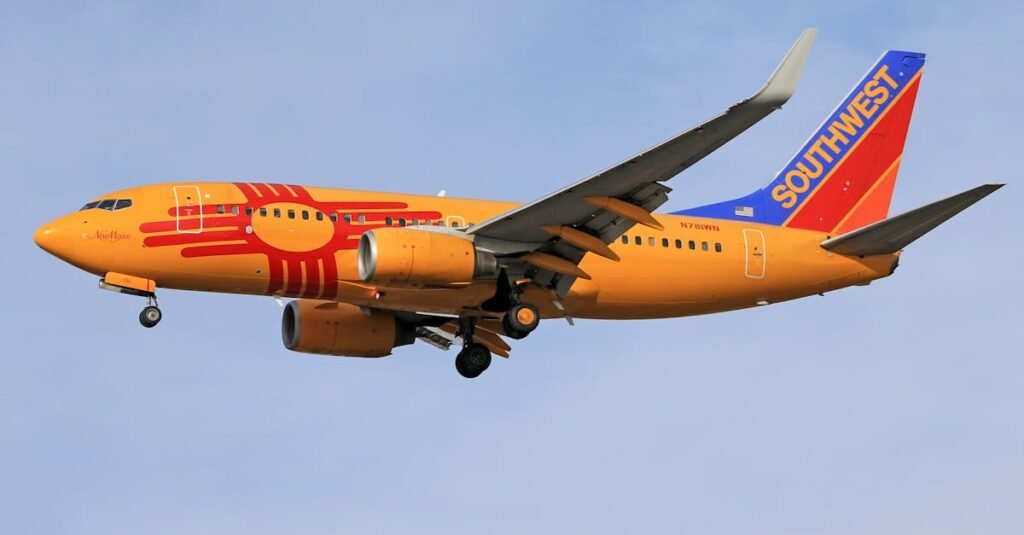
    A Southwest Airlines jet with special livery flying against a blue sky, showcasing aviation technology and travel vibrancy.
    • 18% lower fuel burn per seat.
    • Significantly lower carbon emissions, helping the airline hit its 2030 sustainability goals.

    2. Range and “Thin” Routes

    The MAX 7 has an incredible range of nearly 3,800 nautical miles which is about 1,000 more than the -700. This allows Southwest to fly from mid-continent U.S. cities to Hawaii, or deep into the Caribbean and Central America, without needing a “hub” or a larger, half-empty plane.

    3. Operational Commonality

    By staying with an all-737 fleet, Southwest saves hundreds of millions of dollars in training, spare parts, and crew scheduling. They simply cannot afford to switch to an Airbus A220 without upending their entire cost structure.

    Challenges Remaining for 2026 and 2027

    While the outlook is positive, the “Early 2027” debut is not yet set in stone. Several factors could still sway the timeline:

    • Production Caps: The FAA still maintains a production cap on Boeing (currently around 42 aircraft per month) as it monitors quality control. If Boeing cannot ramp up production by late 2026, Southwest may see its delivery slots pushed back.
    • The “2031 Deadline”: Southwest has set a hard target to retire all 737 Next Generation (NG) aircraft by 2031. To hit this, they need to take delivery of roughly one MAX 7 every week for the next five years which a massive logistical undertaking.
    • Regulatory Scrutiny: The FAA is operating under a “zero-shortcut” policy. Any minor anomaly found during the summer 2026 flight tests could result in a multi-month delay.

    The Strategic Path Forward for the Southwest Fleet

    The arrival of the MAX 7 in 2027 represents more than just a new plane; it is the linchpin of Southwest’s broader business transformation. As the airline moves toward assigned seating and an enhanced cabin experience in 2026, the MAX 7 will be the first aircraft to enter the fleet fully equipped with these new standards from day one. This includes the high-speed USB-A and USB-C power ports, larger overhead “Space Bins,” and the quieter engine profile that passengers have come to expect from the MAX 8.

    From a network perspective, the delay has acted as a bottleneck for Southwest’s “long and thin” route ambitions. While the MAX 8 is perfect for heavy-demand routes like Las Vegas to Phoenix, the MAX 7 is the surgical tool required to make smaller markets profitable over long distances. For example, direct flights from mid-sized cities in the Midwest to Hawaii or deeper into Central America become much more economically viable with a 150-seat aircraft that burns significantly less fuel.

    Furthermore, the 2027 debut aligns with Southwest’s aggressive goal to be an all-MAX operator by 2031. To achieve this, the airline must maintain a seamless “delivery machine” with Boeing. Any further slippage beyond early 2027 would not just delay a debut it would threaten the airline’s long-term cost-reduction targets and its ability to compete against carriers with newer, more diverse fleets. For now, the “August 2026 certification” remains the date to watch.