
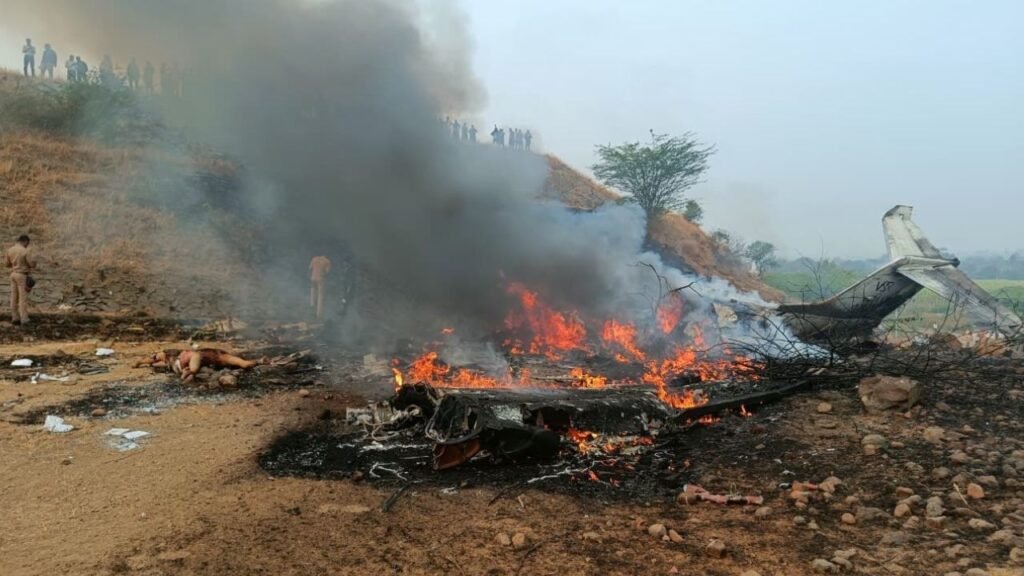
A Bombardier Learjet 45 business jet tragically crashed in Baramati, Maharashtra, India, early on January 28, 2026, killing all five people onboard, including Maharashtra Deputy Chief Minister Ajit Pawar. The aircraft went down while attempting to land at Baramati Airport, about 250 kilometers southeast of Mumbai, prompting an immediate investigation by Indian aviation authorities.
The aircraft, identified as a Learjet 45 (registration VT-SSK) operated by VSR Ventures Pvt. Ltd., departed from Mumbai around 8:10 a.m. local time, flying a short regional route to Baramati. Flight tracking data suggests it was airborne for roughly 35 minutes before radar contact was lost.
Final Approach and Crash
According to early reports and eyewitness accounts, the Learjet encountered trouble during the landing phase, possibly while attempting an emergency approach. Officials from the Directorate General of Civil Aviation (DGCA) India’s national aviation regulator confirmed that the jet crash-landed near the runway at Baramati Airport. The aircraft veered off course, struck the ground, and immediately caught fire, leaving wreckage and debris scattered across an open field near the threshold of Runway 11.
Local eyewitnesses described hearing multiple explosions as the aircraft hit the ground and disintegrated on impact, further underscoring the severity of the crash.
Victims on Board
The five people onboard included:
- Ajit Pawar, Maharashtra Deputy Chief Minister
- Two crew members (pilot-in-command and first officer)
- A personal security officer and an attendant
Tragically, none of the occupants survived the crash. Emergency responders reached the scene quickly, but the severity of the impact and subsequent fire left no survivors.
The Learjet 45: Aircraft Background
The Learjet 45 is a mid-size business jet manufactured by Bombardier Aerospace, widely used for executive, VIP, and charter flights. With a typical seating configuration for up to eight passengers and a range suitable for short-to-medium routes, it has long been a popular choice among private and corporate operators around the world.
While the Learjet family has enjoyed a strong reputation in business aviation, this latest accident will undoubtedly draw scrutiny from the global aviation community, particularly around maintenance practices, approach procedures, and safety protocols at smaller regional airports.
Investigation and Next Steps
India’s DGCA has launched a formal investigation into the crash. Early inquiries are expected to focus on flight data records, weather conditions at the time of landing, and aircraft performance data to determine what led to this devastating event.
As the aviation world watches closely, this tragedy serves as a sobering reminder of the risks inherent in regional business jet operations — especially during critical phases of flight like landing.