The global aviation landscape is often defined by thin margins and intense competition, but Etihad Airways has just rewritten the rulebook. In its latest financial disclosure for the full year of 2025, the Abu Dhabi based carrier announced a record breaking profit after tax of $698 million. This represents a massive 47 percent jump compared to the previous year, proving that the airline has firmly moved past its restructuring phase and into a period of aggressive, profitable expansion.
A Financial Masterclass in a Tough Industry
To understand the scale of this achievement, one has to look at the wider context of the airline business. The International Air Transport Association recently estimated that the average net profit margin for the global airline industry sits at around 3.9 percent. Etihad Airways has completely bypassed this benchmark, posting a net profit margin of 8.4 percent. This means the carrier is performing at more than double the efficiency of its global peers.
Total revenue for the year reached $8.4 billion, a 21 percent increase that was fueled by a surge in both passenger and cargo demand. This financial health has allowed the company to generate nearly $2 billion in operating cash flow. Such a strong cash position is vital because it allows the airline to fund its massive future investments without relying heavily on outside debt. In fact, the airline has successfully reduced its debt levels while simultaneously growing its fleet at a record pace.
Passenger Growth and the Power of Abu Dhabi

The year 2025 saw 22.4 million people choose to fly with Etihad. This is a 21 percent increase in passenger volume, a figure that is nearly unheard of for a full service carrier of this size. Much of this success stems from the strategic importance of Zayed International Airport. The airline now accounts for roughly half of all passenger growth in the United Arab Emirates, acting as a massive engine for the local economy.
Interestingly, the airline is not just acting as a bridge for connecting flights. Point to point traffic to Abu Dhabi rose to 5.5 million travelers. This shows that more people are choosing the capital city as their final destination rather than just a stopover point. Additionally, the airline’s specialized stopover program more than doubled in 2025, bringing 170,000 visitors into the city to explore the local culture and attractions before heading to their next flight.
Scaling the Fleet at Lightning Speed
One of the most difficult tasks for any airline is growing the fleet without losing operational quality. During 2025,Etihad added 29 aircraft to its lineup, bringing the total operating fleet to 127. This was the largest single year expansion in the history of the company.
The new additions were not just standard replacements. The airline introduced the Airbus A321LR, which brings long haul comfort to medium distance routes. These planes feature high end cabins that allow the airline to offer a premium experience on routes that were previously served by smaller, less comfortable aircraft. At the same time, the carrier reactivated more of its iconic Airbus A380 double decker jets to meet the heavy demand on popular routes like London and New York.
By growing the fleet, the airline was able to increase its network from 94 to 110 destinations. New routes to places like Atlanta, Prague, Warsaw, and Hong Kong have opened up fresh revenue streams and strengthened the airline’s presence across North America, Europe, and Asia.
Efficiency and the 88 Percent Load Factor
Growth is only valuable if the planes are full, and Etihad has excelled in this area. The passenger load factor reached a high of 88.3 percent for the year. This indicates that despite adding 21 percent more capacity, the airline managed to keep its planes nearly full.
Managing this level of growth while maintaining an 81 percent on time performance rate is a testament to the operational teams behind the scenes. It shows a level of discipline where every new flight and every new destination is carefully calculated to ensure it adds value to the overall network. CEO Antonoaldo Neves has noted that the airline no longer operates any loss making routes, a rare claim in an industry where many carriers fly certain paths just for prestige.
Cargo as a Quiet Powerhouse
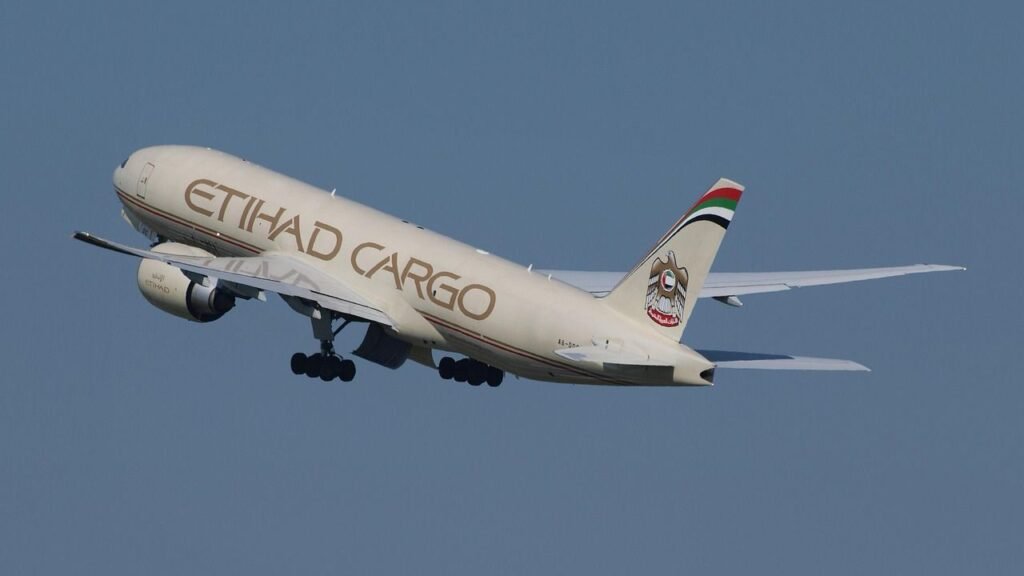
While passengers often get the headlines, the cargo division played a crucial role in these record results. Cargo revenue rose to $1.2 billion, supported by a 9 percent increase in volumes. The airline transported over 700,000 tonnes of goods across the globe.
A major driver of this success was a strategic partnership with SF Airlines, which helped Etihad become the largest cargo operator between mainland China and the Middle East. By using the belly hold capacity of its growing passenger fleet, the airline was able to move high value goods like electronics, pharmaceuticals, and luxury vehicles more efficiently. Specific sectors saw explosive growth, such as the transport of live animals and high value art, proving that specialized logistics are a key part of the modern Etihad business model.
Reinvesting in the Guest Experience
Record profits have not led to complacency. The airline has used its financial strength to reinvest heavily in the passenger experience. This includes a 10 percent increase in the Net Promoter Score, which is a key metric for measuring customer loyalty and satisfaction.
From a brand refresh to a new mobile app and website, the digital side of the journey has been streamlined. Onboard,the investment in First and Business class cabins continues to set new standards. The introduction of the A321LR with lie flat seats in Business class has bridged the gap between short flights and long haul luxury. These efforts have earned the airline over 25 international awards in 2025 alone, ranging from safety honors to recognition for the best economy class experience.
Etihad’s Roadmap for 2030 and Beyond
These results are part of a larger plan known as Journey 2030. The airline is not planning to slow down anytime soon.The goal is to eventually serve 38 million passengers annually with a fleet that could reach 200 aircraft by the end of the decade.
The strategy focuses on organic growth rather than risky acquisitions. By using its own cash to buy new planes and expand into new markets, Etihad is building a sustainable future. The recent credit rating upgrade from Fitch to AA minus confirms that the financial world sees this as one of the most stable and well managed airlines in the sky today.
Why This Matters for the Aviation World
Etihad’s success is a signal to the rest of the industry that a focused, disciplined strategy can overcome global economic headwinds. By balancing luxury with operational efficiency and local growth with global connectivity, the airline has found a winning formula.
As we move further into 2026, the focus remains on delivering what the airline calls extraordinary travel experiences.With 20 new aircraft expected to arrive annually over the next few years, the carrier is well on its way to becoming a top tier global powerhouse. For travelers, this means more choices, better cabins, and a more connected world. For the competition, it means that the airline from Abu Dhabi is no longer just a participant in the market; it is setting the pace for everyone else to follow.