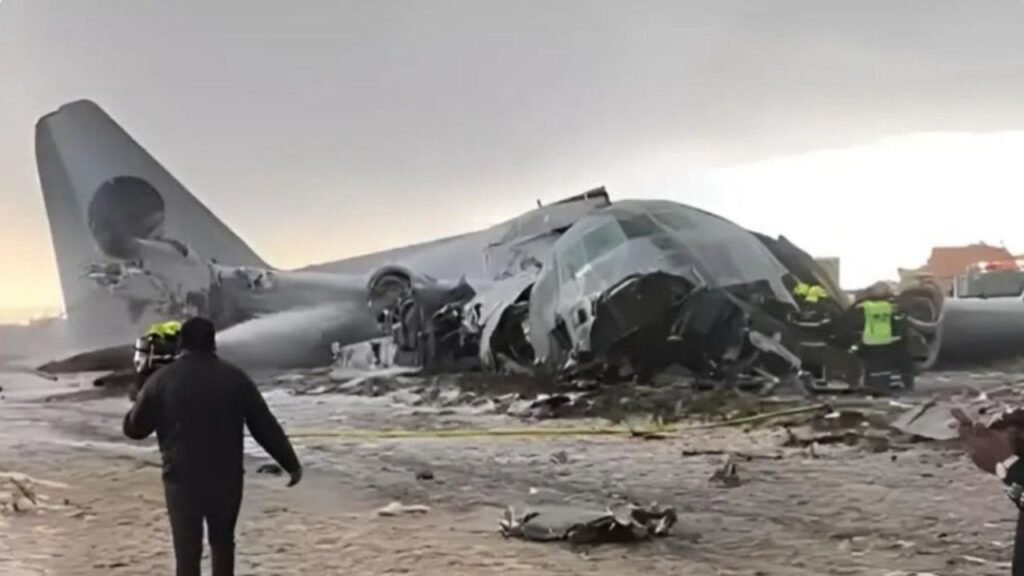
The city of El Alto, situated on the high plateau overlooking La Paz, became the site of a horrific aviation disaster on the evening of Friday, February 27, 2026. A Lockheed C-130H Hercules transport plane belonging to the Bolivian Air Force crashed while attempting to land at El Alto International Airport. The incident resulted in a high number of casualties, significant property damage, and a surreal scene involving millions of scattered banknotes that led to a secondary crisis on the ground.
Details of the Flight and the Crash
The aircraft, identified by its registration FAB-81, had departed from Viru Viru International Airport in Santa Cruz de la Sierra earlier that afternoon. It was performing a routine but high-security transport mission, carrying a cargo of newly printed banknotes destined for the Central Bank of Bolivia in the capital.
As the plane approached the runway at El Alto around 6:20 PM local time, weather conditions in the area were reported as treacherous. Eye witnesses described a severe hailstorm accompanied by frequent lightning strikes and very low visibility. During the final moments of the landing phase, the massive four-engine turboprop veered sharply off the runway.
Instead of coming to a stop within the airport perimeter, the C-130 plowed through the boundary fence and slammed onto Costanera Avenue, a busy roadway that borders the airport. The momentum of the aircraft carried it across the street, where it crushed several civilian vehicles before finally coming to rest in an adjacent field. The impact caused a significant fire, sending plumes of black smoke into the rainy evening sky.
Casualties and Ground Impact
The human toll of the accident is profound. While initial reports from the La Paz Fire Department estimated 15 deaths, the figure was later revised upward as search and recovery teams combed through the wreckage of the plane and the mangled remains of cars on the road. Colonel Rene Tambo, head of the local homicide division, confirmed that at least 20 people have died in the disaster.
The victims include individuals who were on board the military transport as well as unfortunate motorists and pedestrians who happened to be on Costanera Avenue when the plane struck. Among the injured, more than 30 people have been transported to nearby hospitals. Some of the survivors are in critical condition, suffering from severe burns and trauma.
The physical destruction on the ground was equally staggering. Approximately 15 vehicles, including cars and delivery trucks, were hit by the aircraft. One survivor, Cristina Choque, told reporters that she and her family were inside their car when a massive tire from the plane fell directly onto them. While they survived, the incident highlights how close the plane came to causing an even larger catastrophe in the densely populated urban area.
The Scattered Cargo of Banknotes
One of the most chaotic aspects of the crash involved the plane’s cargo. The C-130 was carrying boxes of newly printed Bolivian currency. Upon impact, the cargo hold ruptured, and the wind from the storm scattered thousands of banknotes across the highway and the surrounding fields.
As emergency responders arrived to help the dying and injured, they were met by a large crowd of bystanders who had rushed to the scene to collect the money. This created a major security headache for the authorities. Local media footage showed people stuffing their pockets with cash while ignoring the fires and the danger of further explosions.
To regain control of the crash site and allow paramedics to do their work, the police had to deploy riot gear. Officers used water hoses and tear gas to push back the looters. The Ministry of Defense eventually issued a stern warning, stating that the banknotes had no legal value because they had not been officially registered or put into circulation yet.In a dramatic move to ensure the “valueless” cash did not enter the black market, officials from the Central Bank supervised the burning of recovered money boxes in a large bonfire at the site.
The Status of the Investigation
The Bolivian government has announced a full military and civil investigation into the cause of the crash. Several factors are currently being looked at by experts.
Weather Conditions
The heavy hailstorm and lightning are the primary focus of the early investigation. High-altitude airports like El Alto, which sits at over 13,000 feet, present unique challenges for pilots even in good weather. The thin air requires higher landing speeds, and a sudden storm can make a runway excursion much more likely. Investigators will look at whether the pilot suffered from a sudden loss of visibility or if the aircraft was struck by lightning.
Mechanical Integrity
Technical teams will examine the remains of the FAB-81 to see if there were any failures in the braking systems, the flaps, or the engines. The C-130H is a rugged aircraft, but the age and maintenance history of this specific airframe will be scrutinized to see if a mechanical fault contributed to the plane veering off the landing strip.
Air Traffic Control Records
Communication between the cockpit and the control tower in the minutes leading up to the crash will be analyzed. This will help determine if the crew reported any emergencies before the landing or if they were advised to divert to a different airport due to the weather.
Current Situation at El Alto
The El Alto International Airport was shut down immediately following the crash. All commercial flights were diverted or canceled as the runway and surrounding areas were declared a crime scene. National airline Boliviana de Aviacion (BoA) confirmed the closure and clarified that the crashed plane was a military asset, not a commercial one.
Recovery efforts continued through the night and into Saturday morning. Large cranes have been brought in to move the heavy wreckage of the Hercules so that the avenue can eventually be cleared and reopened to traffic. For now, the area remains under heavy military guard to prevent any further attempts at looting the site.
Conclusion and Next Steps
This crash stands as one of the deadliest aviation incidents in recent Bolivian history. The combination of a military transport mission, a high-value cargo, and a densely populated landing zone created a perfect storm of tragedy and chaos. As the families of the victims begin the process of mourning, the nation waits for answers from the Ministry of Defense.
The investigation is expected to take several months as the black box and flight data recorders are analyzed. In the meantime, the government is facing questions about the safety of flying heavy military cargo over the capital during peak traffic hours and severe weather cycles.